Showing posts with label personal. Show all posts
Showing posts with label personal. Show all posts
Saturday, October 20, 2018
Making another attempt on Mt. Blogger
I love to write, and I find myself taking much time every day composing and polishing bits of text. Often this is for work, but I also write emails to friends, longish documents related to my Catholic faith or to work at our church, and private journal postings for my own use. Back when I was recovering from cancer, I used to post some of my musings here at Standing Here Beside Myself somewhat regularly, but I fell out of the habit when I started working again. I made a couple of attempts at restarting the blog since then, but I guess it was not the time. Now as I approach retirement, I find that the urge to write is constant and growing. A couple of friends have noted that a lot of what I have been writing lately would make good blog fodder. So, I am going to make another attempt at restarting this blog. Here goes.


Thursday, October 11, 2012
Blog Re-Initialization Complete in 3 - 2 - 1 ....
I started this blog on 10/2/2006, and continued to post to it through most of 2007. My last entry was on 11/24/2007, almost 5 years ago. Throughout that period, I had posted semi-regularly. This was easy to do, since I was on medical leave fighting off cancer. But there were issues with keeping my medical insurance (which I obviously still needed). So, early in 2007, I was able to start work part-time with a friend's company, specifically so that I could get that insurance coverage. Sadly, because of how limited my energy and stamina became, I could not devote much time to non-essentials, like blogging. My posts grew less frequent, and eventually stopped.
Today, I am in a somewhat better situation. I have been in remission for over 5 years. Even better, I have been able to drop off almost all of the medications that I had been taking during that entire time. Although these drugs had been necessary to my recovery, they also took a physical toll on me. Frankly, I am relieved to be off of them. I have also gotten a little better at conserving my energy so that I don't burn out as often as I used to. I do have to be careful, because it is easy for me to overdo it.
Because of the above changes, I feel like I can now afford to take time to blog at least a little bit. More importantly, there have been some recent events that have had a big emotional and practical impact on me and my family. I believe it will be helpful, at least to me, to blog about these different changes in our life. Also, the topics I hope to touch on may be of interest to my family and friends, at least for a while.
Let's see if I can turn a good intention into a good habit.
Sunday, January 28, 2007
Thawed Out But Still Behind
Once you get behind, it certainly is hard to get caught up again. The power outage of two weeks ago took a big toll in almost every part of our life here, my writing included. As I described a few days later, we eventually got our power back and began to put everything back in place.
However, I was not really able to get back into my normal pace once power returned. I'm not complaining, though, since the reason was that I started a new part-time job, something that my family and I are very happy about.
I haven't worked since March 11, 2005 when I went on medical leave to deal with multiple myeloma. During the intervening months since then, my employer decided that they didn't need my position any more and terminated me in absentia. Their reasoning in that decision was quite faulty, in my opinion, but perhaps it's just as well. The company has continued to do poorly under that same management, and it doesn't look like it will survive long anyway.
Since I was terminated, I have been able to continue my family's healthcare coverage using a COBRA extension. This allowed us to get the same coverage by paying the insurance premiums ourselves. However, doing so is almost prohibitively expensive. Our coverage currently costs over $11oo/month. Worse, one can use a COBRA extension for only 18 months. One way or the other, I knew that I was working with a limited amount of time to find an alternate means to provide healthcare insurance.
My new employer made me a very generous offer that allows me to work at a reduced pace, yet maintain decent healthcare insurance. Moreover, the work itself will be quite interesting, and I should be able to make a useful contribution. Another bonus is that I'll be working with some old friends, whom I have collaborated with a number of times over the past 15 years or so.
I started this new position on January 22, 2007, and I have been quite busy ever since then. There has been the usual bit of administrivia, filling out a seemingly endless number of forms, all asking for slightly different variations of the same information. There has also been a fair amount of computer setup, trying to get my laptop properly configured to work both inside the corporate firewall, and through a VPN connection from home. And of course, I've been trying to learn more about the tasks at hand.
My first project involves my becoming very conversant with a scientific programming language called Interactive Data Language (IDL), which is a quasi-descendant of the venerable Fortran (a language I first used in 1968). My new employer has built up a large body of legacy IDL code that needs to be re-organized and cast into a more readily usable form. I've always said that I'm really a frustrated librarian, so I expect that I'll be able to do some good here.
I find blogging to be therapeutic, so I have really missed my regular writing times. I'll be trying to re-balance my schedule so that I can get back to those. I'm glad that I'm only working part-time. One of my frustrations these past few months is the realization at how much more 'inefficient' my life is now. Everything I do seems to take longer than it used to. Although I am in remission, I still have a large number of medically related tasks that take up significant parts of the day. Also, I need more sleep than I used to be able to get by with. Finally, I am just plain slower than I used to be. Every activity, from eating to walking down a hall, I now have to do at half the speed I used to be able to manage. On off days, I'm even slower than that. I guess I'm supposed to learn patience from this. So will everyone else, if they are waiting on me. My brain still seems to be working at close to normal speed most of the time, so I'm hoping that I can learn a style of working that makes better use of thinking and less of moving.
Monday, January 15, 2007
Low Power Blues
The nasty ice storm that trashed its way across the middle of the continent has made its way to Michigan. It left about a quarter of an inch of ice on all the tree branches. In particular, it weighed down the branches of a tall white pine tree in our back yard so much that all of them bent way down and some of them broke off. Unfortunately, the tree has grown into the path of the power line and two phone lines that come from the pole in the corner of the yard all the way to our house. So a lot of the bent and broken branches ended up on these lines.
Although none of the lines broke, it was obvious that something was wrong. My first clue was when I turned on the toaster oven in the kitchen early this morning, and all of the lights dimmed to half intensity. A few other experiments confirmed that we were facing a low-voltage situation. Mary and I went around turning off and disconnecting what we could. I powered down Tex, the new server that I'm setting up as our new cavnar.com host. I also turned off several other bits of always-on hardware. I left Tesla, our old server, up, since it provides some services to people besides me. Fortunately, it doesn't seem to draw very much power.
Our power supplier, DTE, is swamped with calls from all over the area. When I called the trouble reporting line this morning, I was informed by a cheerful automated voice that I had to wait approximately 167 minutes to talk to a customer representative. I went back down to the dark workshop in the basement where Tesla lives to see if I could eke out enough bandwidth to contact DTE's web-based trouble reporting. I was successful, I guess. The choices for the kind of problem I was experiencing seemed inadequate. The line wasn't down, so I had to settle for checking the box that indicated that our power was intermittent. I've gone back to the site a few times to look at our status, but their system is still unable "at this time" to give an estimate of when they can look at the problem.
I called the phone company, but they won't come out unless a phone line is actually down. I finally managed to call the tree trimming service that did a bunch of work for us about a year and half ago. One of their guys came out about an hour ago. He was able to get all the branches off the wires using just his long pruning pole. However, once all of the branches were out of the way, I was able to see the real problem: the power line, although not broken, has pulled partially away from the pole. I can't tell for sure, but I'm guessing we've lost one of the two incoming phases for our power. So, we're still stuck until DTE graces us with an on-site presence.
Mary and Tim seem to be taking this a lot more cheerfully than I am. Mary has always been much more prepared to go low-tech. (My old joke is that I don't really know how we got together in the first place, because she wants to live in the 19th century, and I'm still mad because it's not already the 24th.) Our son Tim, who spends a lot of time practicing on his electric and acoustic guitars, is off from school because of Martin Luther King Day. When I told him, he immediately replied "I guess this means it's an acoustic sort of day". He knows what to do and isn't whining about it (yet). But old geek that I am, I feel significantly disoriented. It took some soothing talk from my wife and a bit of creative re-prioritizing with her to find a way to use the day effectively without being online continuously. Even so, here I am, sitting in the dark, typing on an old keyboard by candle light (seriously!) just so I can get my blogging fix. In a way, it might have been easier (or at least simpler) if it had been a complete outage.
I hope it is warm, dry and well-powered where you are.
Monday, January 08, 2007
Shilling For Google And Netflix
Over the holidays, I had a number of occasions to chat with family and friends. Toward the end of the break, I began to realize how often I ended up evangelizing for Google and Netflix. This was disturbing to recognize, because in the past I myself had often been critical of people who were overly laudatory about some company's products.
For example, back in the early 1990s, I worked for a large contract research house. One of my fellow employees, otherwise a fine individual, was a monomaniac about Lotus Notes. His basic view was that it was good for whatever problem you had, so he brought it up in every meeting he attended. This greatly irritated me, because (1) I thought the product was over-priced, (2) regardless of what my friend thought, Lotus Notes was not the magic bullet that would cure all our ills, and (3) I wanted to develop such systems myself, and there was no way I would be able to do that if the company spent a lot of money buying one. I needn't have worried. The product was too expensive, and I left the company anyway.
Then there are Microsoft zombies. These are people for whom the answer to any problem is a Microsoft product. There are not anywhere nearly as many nowadays as there were, say, ten to fifteen years ago. Back then Microsoft was the only acceptable desktop application vendor for a large corporation. A Microsoft zombie in a management position was every bit as repressive as any party official in a totalitarian state. Of course, the synergistic interplay of the Internet and open source software has taken a lot of the wind out of Microsoft's sails.
Like Microsoft in the 1980s and 1990s, other companies have had their own dittoheads. Both IBM and Oracle won my disdain early on because of this, although it seems they both have lost the adoring crowds that once followed them.
Since the late 1990s, I have mostly been plumping for open source stuff. There are lots of reasons for this, including lower costs, usually higher quality for the things I cared about, and more diversity. Nearly all of my geek friends felt the same way. There was something really gratifying about endorsing and using software that was free to download and install. I didn't mind at all telling people about it, and I argued with commercial software dittoheads on more than one occasion about why open source made sense for commercial companies.
Then Google came along. They are not an open source organization by any means, although they make heavy use of an open source infrastructure. Somehow Google managed to establish a pretty lofty reputation among geeks even though they were a commercial outfit. Part of this reputation came from their "Don't be evil" slogan. Probably an even bigger part was the fact that their most useful service, namely searching, was free. Google found a non-offensive way to present relevant ads along with search results, and users gladly accepted that as the cost of getting such a great service. For a good long while, about the only people critical of Google were competitors.
Google began branching out into other products, including the ones that I regularly use: Gmail, Google Maps, Google Earth, Google Video, Google Reader, Google Chat, Blogger and Picasa. These are all 100% free, and they have changed the way I do things every day. It has gotten to the point that if Google rolls out a new product, I almost never bother to look at what competitors have to offer. Even worse, I evangelize for these products. I tell people what great things they are. I have become just like my Lotus-Notes-loving friend. I am a Google shill.
As if that weren't bad enough, I found myself doing the same thing for Netflix. In case you don't know about that (I was surprised that some of my non-geek friends had never heard of it), Netflix provides an extremely easy-to-use DVD rental-by-mail service. For a relatively small monthly fee, you can request DVDs online, and they are mailed to you as they become available (usually there is no waiting). You keep them as long as you want, but you can only have a certain number out at a time. When you are done with a DVD, you mail it back in, and then Netflix will send you the next one you requested. The best part of Netflix, in my view, is the incredible range and variety of material that they have available: old classics, whole TV series, rare and seldom seen masterpieces, etc. Searching and requesting are very easy.
So, here I am . The only thing that keeps me from being a true shill is that I don't get anything out of my evangelizing, at least not in a monetary sense. But then, neither did my Lotus-Notes-loving friend. The real question is whether this change is because I am growing morally weaker, or just mellower.
Tuesday, December 26, 2006
Hiding In Plain Sight
I have a vision problem. Unfortunately, it's not one that can be remedied with an optometric prescription, laser surgery or medication. The heart of the difficulty is that sometimes I don't see what is right in front of me.
It seems to happen in any number of purely domestic situations. For example, my wife Mary tells me that there is a certain food container in the refrigerator with something in it which I will like. I go stand in front of the refrigerator for long minutes, peering high and low, moving things around, but, alas, I don't see it. I call Mary. She walks up, opens the refrigerator, immediately puts her hand directly on the invisible item (without moving anything), picks it up, and hands it to me. The same thing happens with some regularity for clothes in my closet, almost any kitchen item smaller than a gallon milk jug, and most items in our office. It also happens with tools and materials in my workshop.
A couple of days ago, I had a somewhat more serious episode of this selective blindness that troubled me. Because of the cancer I am recovering from, I take a number of drugs and supplements. Naturally, these come in bottles of various sizes, which run out at different rates. We try to keep ahead of that by periodically checking the levels, and then calling in refills to the pharmacy. After we pick up those medicine containers at the pharmacy, we put them in a special place so that we will be ready to switch quickly when the current nearly-empty containers run out.
On the Friday before Christmas, I went through this level-checking drill and realized that one of the meds I take, which comes in liquid form, was going to run out before the weekend was over. I called in a refill as usual. Later in the afternoon, when I went to pick up this refill, the pharmacist told me that the insurance company had rejected the refill request because it was too soon by at least a week. In other words, according to them, I shouldn't have run out yet. I explained that, whatever the insurance company thought, I would be out of that particular medicine in one or two days.
The people at the University of Michigan Cancer & Geriatrics Center Pharmacy have become great friends, and they always go out of their way to help us. The person there who handles the phone and the insurance went right to work, and somehow bludgeoned the insurance company into accepting the claim. It took twenty minutes or so, but I was glad to wait for it. I thanked my pharmacy friends profusely, tooks the meds, and headed home.
Mary, who had not been involved in this particular refill request, put the new containers in the appropriate spot when I got home. A couple of days later, when I finally exhausted the current bottle, I went to get the next one. The refill bottle I had just picked up was there, but to my surprise I saw that there was also one more bottle. This was the one that the insurance company must have thought that I had. I swear that I looked in the refill spot before I called in the order. And it's not like it was one of a dozen identical little pill bottles, either. It was a relatively big container, roughly the size of a typical cough medicine bottle.
How could I have missed it? Why does this keep happening? How can I miss seeing items that are obviously right in front of me? Certainly it has to do with focus of attention, but what does that really mean here?
One could speculate that perhaps this selective vision has to do with how much one likes or desires the thing looked for. In other words, I would more readily see something I desire and less readily see something I did not desire. However, that doesn't really explain it. When I stand in front of the refrigerator, I am hungry and I desire food. In fact I desire the particular food I am looking for. Why cannot I see it? Similarly, I want to get dressed, so why can't I see the shirt I want hanging in front of me? I want to take the medicine because it is necessary for my health, so how could I possibly miss seeing it there on the shelf?
Upon reflection, I think this kind of vision error has to do with the degree of affinity or liking, not for the item looked for, but rather for the activity which the seeing is part of. I like food, for sure, but I dislike food preparation. It is almost as if, in my juvenile way, I'm still wanting someone to prepare all my meals for me. Mary in fact does the bulk of the food prep here and does a wonderful job of it without complaint. However, she does not and should not have to prepare absolutely everything I eat. I can manage at least a sandwich or bowl of soup without spousal assistance. The thing is, I don't like spending my time this way. I hate putting in more time preparing the food than it takes to eat it. My guess is that this dislike somehow negatively primes my visual recognition ability.
Mary, on the other hand, gets great satisfaction out of doing those very things I dislike so much. She has very little problem seeing things in the kitchen, the closet, or pretty much anywhere else in the house. Now that I think about it, our kids often suffered from the same kind of blindness while growing up, and likewise had to depend on her (e.g., "Mom, where are my shoes?" "You left them under the coffee table.")
However, Mary does have her vision problems, too. I realized this while helping her over the last number of weeks as she learns how to use Windows XP. She does not like computers, but she realizes that she has to be able to use them to some degree given the prevalence and usefulness of email, web browsing, etc. It turns out that Mary has this same kind of selective blindness when it comes to looking at the Windows desktop. I'll say something like "OK, see the little box to the right of the cursor?" or "Now click on the 'Move File' link in the left hand column", but those location descriptions are not useful for her. When Mary looks at the screen, she sees a confusing mass of text and icons. She does not see things that are right in front of her. Needless to say, this has been a continual source of difficulty for her in getting comfortable with Windows.
On the other hand, when I look at a computer screen, I take in the whole thing almost instantly, identifying all the points of interest without trying. I very rarely miss any important detail. In fact, at times I've been able to diagnose colleague's bugs or find typos in their prose with no more than a passing glance at a screen-full of text. You might say, "Ah, but perhaps it is just a matter of practice." Maybe, but I've always been that way with computers, all the way back to when I did my first programming in 1967 in a high school summer program. I took to computers like a bee to a field full of honeysuckle -- I needed no encouragement and no instruction. Obviously, I liked computers. I suspect that preference primed my visual recognition so that I always spotted salient details on a screen or printout very quickly.
So, perhaps one's ability to see things in a given context is modulated by how much one likes the activity that the seeing is part of. If so, what do you do when faced with an activity that you don't like to do, but that you have to do? The kind of seeing or blindness I've been talking about is an unconscious thing. Willpower will avail you little in fighting the unconscious. I'm not sure how I should approach my own issue in this regard. Now that I recognize this performance shortcoming in myself in certain domains, I can at least try to take it into account. For example, I suspect that slowing down will help. I am naturally inclined to hurry through activities I dislike, which aggravates the blindness problem. If I slow down so that I truly look, I'll bet I'll see more than I have been seeing. Also, "no man is an island" (Paul Simon notwithstanding), so I should also just accept the fact that my blind spots and Mary's blind spots are at least complementary.
Monday, December 25, 2006
Merry Something-Or-Other
I have been wanting to wish all my readers a Merry Christmas for several days, but I've been wondering how I should do it. The PC notion of a completely neutral seasonal greeting still irks me, although I know perfectly well why people feel that is necessary. Of course, I don't want to offend anyone deliberately, or attempt to manifest my allegiance to a Christian American cultural hegemony. Still, it seems obvious to me that, if someone gives me a greeting or blessing or good wish or whatever that is pecular to their particular culture or group, they are doing so with a good intention. If someone is doing something from a good intention, and it doesn't actually harm me, why should I do anything except gratefully receive it? After all, they aren't cursing me or saying bad things about my ancestry.
A number of years ago, my employer sent me to an affiliate company's site in Paris. While there, I was often caught off-guard when people would wish me a pleasant Bon Jour as I passed them in the halls or on the streets. It was the appropriate greeting for them, and they clearly meant it well. Only an Ugly American would have taken offense. Instead, I took some small delight in the greeting and its novelty to me, and did my best to return the greeting (although doubtless my American accent immediately gave me away).
Given all that, let me wish you a very Merry Christmas, and express my hope that you find this day and the whole season a happy time for yourselves and for those close to you.
Wednesday, December 20, 2006
Reflections On A Red Cross Donor Card
 A few days ago, I was cleaning out my wallet, removing some of the detritus of the past year. It's almost embarrassing to see how much useless stuff that I have been carrying around. Anyway, among the items I found was my Red Cross Blood Donor ID card. I've been an RC donor since the early 70s. According to the RC records, in the 31 years or so that I have lived in Michigan I have donated 80 units of whole blood. I have always donated several times a year, and in recent years I have often hit the legal limit of five donations a year.
One of the reasons that I donated so regularly (besides the fact that it's just a good thing to do) was that I have an O Negative blood type. Only about 8% of the population is O Negative, but the really valuable thing about that type is that it makes me a 'universal donor'. That is, pretty much anyone needing blood could take my O Negative blood regardless of what their type was. Every time I donated, I would be reminded of my 'specialness'. Frequently, the RC would also send snail-mail reminders, which always mentioned the need for O Negative blood.
I really didn't mind donating at all. Unlike some of my fellow donors who became faint or dizzy after a donation, I never had any trouble at all. Instead, I always looked forward to the cookies and juice they provided in the 'recovery' area after a donation. Even more valuable to me was the fact that donating presented a good excuse to get out of the office.
This happy situation lasted until about two years ago, when I began having serious health problems. Around Thanksgiving 2004, I contracted a nasty cold/flu of some sort that I just couldn't shake. The RC rules are that if you have an active infection, you aren't supposed to donate. Unhappily, this infection lasted for many weeks, frustrating several scheduled attempts to go donate.
In a previous post, I warned that I might get tiresome talking about the following subject, so don't say I didn't tell you. Going into 2005, the cold/flu thing continued, but I also started developing other unpleasant symptoms. This prompted a number of rounds of doctor's visits to figure out what was happening. Finally, on March 10, 2005, I learned that I had contracted multiple myeloma, a serious bone marrow cancer. The day after I got the diagnosis, I started some heavy chemotherapy, which then continued for a number of months. Later I had a couple of bone marrow stem cell transplants. All of this high-intensity medical activity undoubtedly saved my life, but it also meant that I would never again be able to donate blood.
Rather, over the course of the months following the initial diagnosis, it turned out that I needed to receive a number of blood transfusions. Although I don't think I have received 80 units back, I know I have put a good dent in that number.
There were several reasons I needed the blood. At first, I was suffering anemia simply because my bone marrow was full of cancer cells instead of normal tissue, and so I was not producing enough red blood cells. At the time of my diagnosis, my bone marrow consisted of 70% cancer cells. It was no wonder that I felt tired and out of breath all the time.
As I mentioned, I went through a lot of chemotherapy, which killed a lot of the cancer cells. Then, in preparation for my first stem cell transplant in August 2005, I received a massive dose of a chemotherapy agent called melphelan. This drug killed even more of the remaining cancer cells. However, it also killed off most of the healthy cells in my bone marrow. (This was actually part of the plan for the transplant.) After that treatment, I then received an infusion of my own previously harvested bone marrow stem cells. From those cells, I regrew new bone marrow tissue. Naturally, that took some time, so I needed a few transfusions to bolster my red blood cell supply before my newly regenerated bone marrow could get back on the job.
Finally, in October 2005 I received a second stem cell transplant, using stem cells donated by my sister Bliss. This time there was no preliminary 'conditioning' or 'induction therapy' (kinder, gentler terms for chemotherapy). I simply received an infusion of her stem cells. Over the course of some days, those cells found their way into my bone marrow and set up shop.
It took many months, but eventually my sister's stem cells, which were healthy and vigorous, supplanted my own weakened cells. I don't remember exactly when it happened, but after a number of months the DNA tests the lab did on my blood showed that I was '100% donor cells'. Even more interesting, and perhaps amusing, was the wording in a July 7, 2006 cytogenetic analysis report:
The presence of a normal female karyotype in this sample is consistent with the engraftment of cells from a female donor following peripheral blood stem cell transplantation.In other words, the transplant had been a complete success. My bone marrow was a clone of my sister's, and the blood cells it made were just like hers. It almost looks like a sex-change operation for blood cells. I like to joke that if I ever commit a crime, and leave some blood at the scene, the cops will be looking for a woman. (Someone else pointed out that this would make an interesting plot device for a CSI episode. But I digress.)
There was one niggling detail to spoil this medical success story. My sister was a perfect tissue match for me, as measured by the usual way that one does such matching. However, she had an A Positive blood type. I mentioned earlier that having O Negative blood made me a universal donor. Unfortunately, given the way blood type matching worked, that also meant that I could only receive O Negative blood. This more stringent matching requirement also included new blood cells generated in my own body.
So, while my new bone marrow was busily making new A Positive red blood cells, what was left of my old immune system was promptly killing them off because they were not O Negative. The left hand giveth, while the right hand taketh away, and all that. My new bone marrow was apparently producing plenty of new blood cells, but they never got a chance to do much good before they got wiped out. That meant that I had to keep getting O Negative blood transfusions.
This problem started right after the transplant in October 2005 and went on for a number of months. I received several treatments aimed at correcting the mismatch, but they took a long time to have an effect. Frankly, I was beginning to wonder if I was going to have a permanent problem with this internal blood type mis-match. The prospect of needing blood transfusions in perpetuum was not a happy one for me (or our insurer, I'd bet).
However, right around the end of May 2006, the old immune system finally gave up the ghost, and stopped killing off my new blood cells. When that happened, my hemoglobin level, which had been hovering in the 6-8 range for months, shot up to the 14-16 range, which is normal for an adult male.

(Perhaps you can't quite make out the numbers and dates on the axes of this graph, but hopefully you can see the sharp rise from late May to early July.) Needless to say, we were pleased. In fact, we were overjoyed. I haven't needed a transfusion since that rise. (The graph also shows a little bump around mid-October, but that's a different story.)
This brings me to the insight that flashed through my mind when I pulled out my RC donor card. Ever since the ABO blood typing system was first figured out by medical researchers, a person's blood type was thought to be immutable. Yet, now we know that under the right circumstances, it can change. What other characteristics of a person that we think of as fixed and unchanging are actually mutable, given the right conditions?
I have a friend, a very successful businessman, who fits the classic profile for a Republican supporter. He in fact was a Republican, as evidenced by his financial donations and his participation in party events. Yet, in the years since Bush's election, he has done a complete 180° politically. He now actively (and financially) supports various Democratic candidates, and debates his still-Republican pals in a friendly, but vigorous way. Knowing him as long as I have, I was rather surprised by the switch. Yet for him, the change was necessary, even unavoidable. He was repeatedly and increasingly distressed by the actions of the current Administration, as well as by numerous Republican misdeeds in his own state. As Popeye put it, "That's alls I can stands, 'cause I can't stands no more".
We have all been surprised by people we thought we knew well who did something completely unexpected. A confirmed bachelor finally gets married. A couple we thought had been happily married for decades gets a divorce. A well-known religious figure who had railed against immorality turns out to be a pedophile and porn addict. A hard-core atheist becomes a fervent believer and evangelist.
We may view some of these changes as unfortunate, or even tragic. Other changes, particularly those of a religious or ideological nature, are often viewed with suspicion. Those who disagree with a person's new views are likely to see him as a traitor or a 'flip-flopper'. However, it seems to me that the very notion of free will doesn't mean very much unless it allows the possibility of a person making this kind of deep, fundamental change. And you have to admit that resisting obviously needed change is just self-destructive: staying the course was definitely a bad idea for Captain Ahab.
In many things I am a conservative, in the older sense of being predisposed to limiting change. However, as I grow older, I am coming to appreciate the value, even the necessity, of allowing and accepting change in others, and especially in myself. After all, if I can change blood types, then who knows what other kinds of changes I have in my future?
Wednesday, December 13, 2006
VGPR
Back in March 2005, I was diagnosed as having multiple myeloma, a very nasty cancer of the bone marrow. My family and I had an especially strong reaction to this diagnosis because this was the same cancer that killed my father in 1985. Since my diagnosis, I have been through a lot of stuff, including four rounds of intensive chemotherapy and two bone marrow stem cell transplants. The second transplant used stem cells from my sister, and was ultimately successful. There were several significant complications, including a relapse around July of this year. But thanks to medical advances, a very effective round of additional chemotherapy, and the mercy of God, I have now reached a condition called Very Good Partial Remission (VGPR, in the trade). If I can maintain this state for three years, I can claim the Full Remission label.
My family and I are thrilled. Of course, being a stodgy, emotionally repressed white American male I find it uncomfortable doing a Snoopy-style happy dance, or anything like that. But don't let my lack of shouting and whooping it up fool you. This is the best news I've had in two years. I will probably become tiresome talking about it.
If you would like to read more about my Adventures in Cancer Land, you can peruse the WBC Remission Network site.
Update 11/4/2009: I had to take down the above named website, which had been implemented as a straightforward forum. It was getting hammered by hundreds of spammers trying to post their crap on my forum, and I got tired of dealing with the messages and alerts. I hope to convert my content from that site into a more conventional blog through Blogger/Blogspot soon.
Tuesday, November 28, 2006
Back In The Saddle Again
I was astonished to see how long it has been since I had last posted here. Of course, part of the gap was caused by the great hubbub around my house since Nov. 17, when the first of our far-flung children began arriving for our Thanksgiving holiday. (See photo below.) Since then, I had managed a few reply postings on several of the existing threads, particularly the most recent one about wireless power. Nonetheless, I had intended to be much more faithful about writing. I will endeavor to make up for that now!

From left to right: Shelby (Sam's wife), Sam, Dave, me, Mary, Audra (Mike's wife), Mike, Tim, Becky, and Steve. Missing are Tom and Becky's husband Nate. At the lower left you can see the shadow of our friend Armando, who fortuituously arrived just in time to take our picture.

From left to right: Shelby (Sam's wife), Sam, Dave, me, Mary, Audra (Mike's wife), Mike, Tim, Becky, and Steve. Missing are Tom and Becky's husband Nate. At the lower left you can see the shadow of our friend Armando, who fortuituously arrived just in time to take our picture.
Tuesday, November 14, 2006
Blue Mania
Mary and I had a wonderful visit to Chicago this past weekend to visit our oldest son Sam and his wife Shelby. They just moved there in May, and we had not had a chance to see their new home. We took the train down, which is much better than driving, but still not stress-free. Sam and Shelby took us around to a few favorite places of theirs, but the highlight of the weekend was an unexpected treat Sam came up with. On Saturday afternoon we went to see a matinee performance of the Blue Man Group. It's hard to describe them, since mere words fail. Inspired lunacy? Exalted silliness? A mystical clown act? There's these three guys, see, and their heads are painted blue, and they are fantastic drummers, and they never say a word, although the narrator does sometimes, and they are very ... messy, and ... well, you should definitely go see them if you have the chance.
The audience obviously had a lot of Blue Man fans who were familiar with their performances. It reminded me a little of the zaniness that regularly went on when people watched The Rocky Horror Picture. The raucous behavior of a bunch of Girl Scouts I can understand. But the weirdnesses exhibited by middle-aged women were a bit odd to behold. Anyway, after the performance, the three Blue Men were in the lobby of the theatre so you could take pictures with them. They stayed totally in character and never said a word. We took our time leaving, so by the time we got to the lobby there wasn't a waiting line to get a picture. That's when we got this:
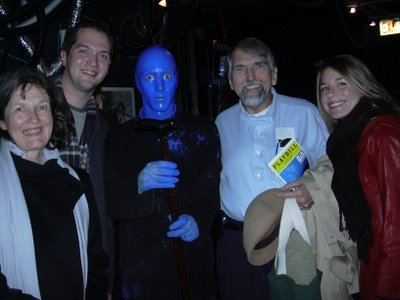
You can't make it out very well, but the Blue Man is holding my cane. I handed it to him to see what he would do. He said nothing, but turned around several times just looking at it. Then when we took the picture, he held it up as you can see.
I even got a little Blue Man blue on my shirt from my close encounter. Mary didn't seem to mind. She said that she wasn't going to wash the shirt.
The audience obviously had a lot of Blue Man fans who were familiar with their performances. It reminded me a little of the zaniness that regularly went on when people watched The Rocky Horror Picture. The raucous behavior of a bunch of Girl Scouts I can understand. But the weirdnesses exhibited by middle-aged women were a bit odd to behold. Anyway, after the performance, the three Blue Men were in the lobby of the theatre so you could take pictures with them. They stayed totally in character and never said a word. We took our time leaving, so by the time we got to the lobby there wasn't a waiting line to get a picture. That's when we got this:

You can't make it out very well, but the Blue Man is holding my cane. I handed it to him to see what he would do. He said nothing, but turned around several times just looking at it. Then when we took the picture, he held it up as you can see.
I even got a little Blue Man blue on my shirt from my close encounter. Mary didn't seem to mind. She said that she wasn't going to wash the shirt.
Monday, October 02, 2006
It's About Time
I've been a long time coming, but I'll be a long time here.
People have been telling me that I should start a blog somewhere. As my friend Karen Fenton once put it "I'm having a moment of inertia." In my defense, I've been kind of sick for a while.
In March 2005 I was diagnosed with multiple myeloma, a very nasty bone marrow cancer. After extensive chemotherapy and two bone marrow stem cell transplants, I'm definitely doing better, but I'm not out of the woods yet. Recently, I have relapsed. (Although since the doctors never declared that I was in remission, I'm not sure telling me that I relapsed is all that informative.) Anyway, there is a protein called immunoglobulin gamma (IgG) which is indicative of how active my particular form of myeloma is. From January to June of 2006, the IgG level steadily fell. However, over the summer it started rising again, to the point that it got almost back up to the January level by mid-August. The doctors put me back on thalidomide, which is one of the drugs I was on for all four rounds of chemotherapy last year. It apparently is pretty effective against so-called 'refractory' myeloma, so we are hopeful that this will help. Unfortunately thalidomide has some pretty serious side effects. The most serious is probably peripheral neuropathy, which is the degeneration of nerves in the limbs, particularly in the hands and feet. The problem manifests itself first with a tingling, pins-and-needles sensation in the fingers. So far that hasn't happened, although I did experience that last year when I was on higher doses of thalidomide. The main problem I'm experiencing now is dizziness, nausea and general dopiness. The only upside of that so far is that thalidomide has cured my insomnia.
Regarding writing, I've been storing up a long list of topics about which I have something to say. At least I think I do. Having never actually written out my thoughts on these topics, it's hard to say how coherent they will be when finally put down as bytes in a database. We shall see.
Subscribe to:
Posts (Atom)